ART
RESOURCE
CRAFT
ARCHITECTURAL &
INTERIOR DESIGN
Grounded
Imagine you are transfixed on the day after your 15-year-old home had been incinerated in a wildfire. Your future evaporated in smoke, and your memories transfigured.
Fast forward fifteen months, and I get a phone call: “We have decided to rebuild.”
Nourishing Home
My role was to help my clients tell the whole story: a story of seeing, sensing, and feeling. Does this feel right? Nourishing Home implies something of the heart, relatable, empathetic, benefit-driven, and reciprocal. A home that is restorative and supports their lives.
We imagined two old buildings on the land—one a stone barn and the other a board-and-batten barn—expressing bygone years. We anticipated restoring the buildings and connecting them with a structure of different materials.
A Story about Stone
Hungarian Agoston Haraszthy founded Buena Vista Winery in 1857. Haraszthy’s cellars at Buena Vista were one of the first stone wineries in the state, and it was this stone building, along with its unique history, that inspired my clients.
Finding the Right Stone
We discovered that the Buena Vista Winery was built with a stone called Tufa, so we began a search for a comparable material. Our building walls were constructed with Insulated Concrete Forms (ICFs). We were looking for a quarry that could provide a 3” thick stone cladding with sizes up to 30” x 22”. Typical stone cladding has a maximum height of 14”. Tufa was not available, yet we were determined to match the range of colors and textures found in Tufa. After a 3-month search during which we rejected many samples, found a quarry that could meet our specifications.
Building a Test Wall
Once the material arrived, the masonry contractor erected an 8-foot-high L-shaped concrete block wall to experiment with stone patterns, grout width, and corner details. It took multiple attempts to establish the look we were trying to achieve. Next, we had to determine the grout material, ingredients, and color by getting the sand mix and organic matter perfectly balanced. And after many experimental formulations, we were ready to go.
A new rural home designed to look like a renovated winery with a modern addition
Arts and Crafts Alive
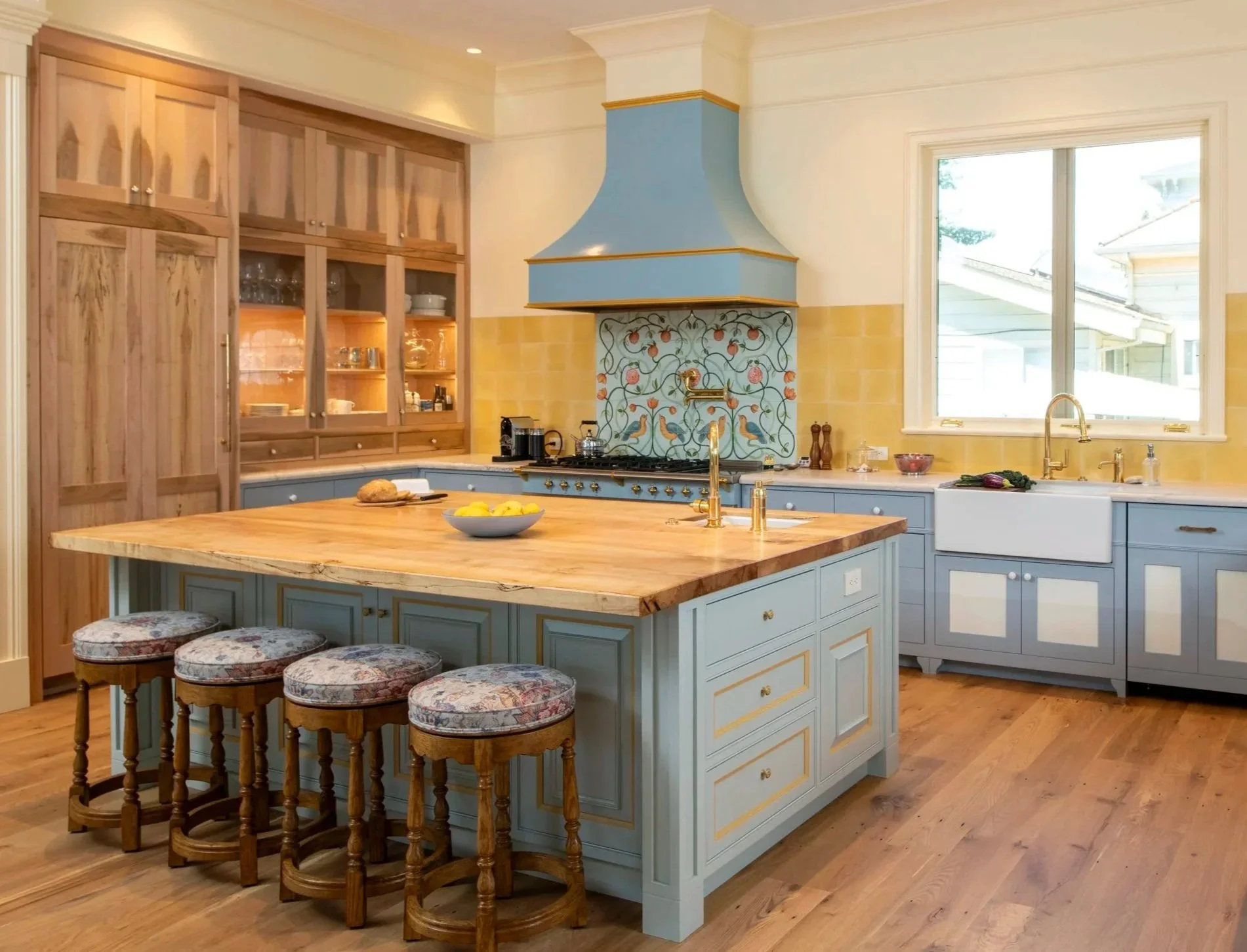
Recently, Marie and I had the opportunity to restore a Victorian house in Northern California, built in the 1880s. The project also included a significant addition that had to complement the original house without copying it. Planning and design restrictions were imposed due to the house's historical significance. The exterior of the original two-story house had to be preserved, whereas the interior was not subject to any restrictions.
In consultation with the clients, a British Victorian influence emerged, and William Morris's work inspired some of the design direction. William Morris (1834-1896) championed handmade craftsmanship during a time when British industrial mass production was at its peak.
William Morris and the Pre-Raphaelites emerged at the onset of the British Arts and Crafts movement, which predated the American Arts and Crafts Movement. In 1861, Morris founded Morris & Co. and initially focused on decorative arts, including wallpaper and fabrics. Morris and his associates also designed furniture, stained glass, painted tiles, tapestries, carpets and rugs, and metalwork. They opposed the transition from artist-craftsman to machine operator, from being "whole" to having a small, fragmented part on a production line. To this day, the work of Morris & Co. is still in production.
We have long admired William Morris for his steadfast support of the artist-craftsperson, and my goal has been to support them in my projects whenever feasible. On a few projects, we had used Morris & Co. fabrics, but in this recent project, we had the opportunity to use their wall coverings, window dressing, and upholstery. We designed, painted tiles, stained glass, and casework in the tradition of Morris & Co.
The person who built the casework, originally from England, graduated with City and Guilds (founded in 1878) awards from the London School of Furniture in both cabinet making and wood machining, and afterward received a Fine Wood Diploma from the Building Crafts College in London. This made him the perfect fit for our project.
The custom tile painter, someone we have worked with for over two decades, transformed Marie’s painted rendering into a unique stove backsplash.
Our front door stained glass manufacturer is a third-generation company. We communicated back and forth until we had a design that corresponded thematically with the stove backsplash. Stepping through the front door is a custom Victorian entry floor tile pattern manufactured in England.
There are too many individual furnishing elements to write about, but one worth recounting illustrates the deliberation required for such a project. We sourced a Victorian cast-iron tiled fireplace insert that had recently been salvaged from a central London townhouse and restored to its former glory. The fireplace included the original eleven hand-painted ceramic art tiles with characters from Sir Thomas Malory's epic "Le Morte d'Arthur" designed by the famous ceramic artist and designer John Moyr Smith. In its new California sitting room, the fireplace is centered on a custom mahogany paneled wall.